Exploring the fascinating Inca Trail map is the first step toward mastering a world-class journey filled with history, mysticism, and breathtaking landscapes. With our comprehensive guide and expert advice, you will be 100% prepared to conquer this unforgettable adventure toward the wonder of Machu Picchu.
1. Introduction to the Inca Trail: The Sacred Path
The Inca Trail is, in its own right, one of the most iconic and coveted trekking routes on the planet. Immersed in the stunning geography of the Peruvian Andes, this trail takes adventurers through a journey where living history blends with vibrant biodiversity.
With a length of approximately 43 kilometers (26.7 miles) in its classic version, the Inca Trail connects several significant archaeological sites, culminating in the majestic citadel of Machu Picchu.
2. History and Significance of the Qhapaq Ñan
The stretch we commercially know as the Inca Trail is actually a privileged section of the Qhapaq Ñan (Inca Road System). This monumental network spanned over 30,000 kilometers, connecting the four corners of the vast Tahuantinsuyo Empire.
Did you know? The path to Machu Picchu was not an ordinary trade route, but a restricted access way for sacred pilgrimage. UNESCO declared the Qhapaq Ñan a World Heritage site, and today, following its coordinates means walking through the very history of South America.
3. What Does the Inca Trail Map Include?
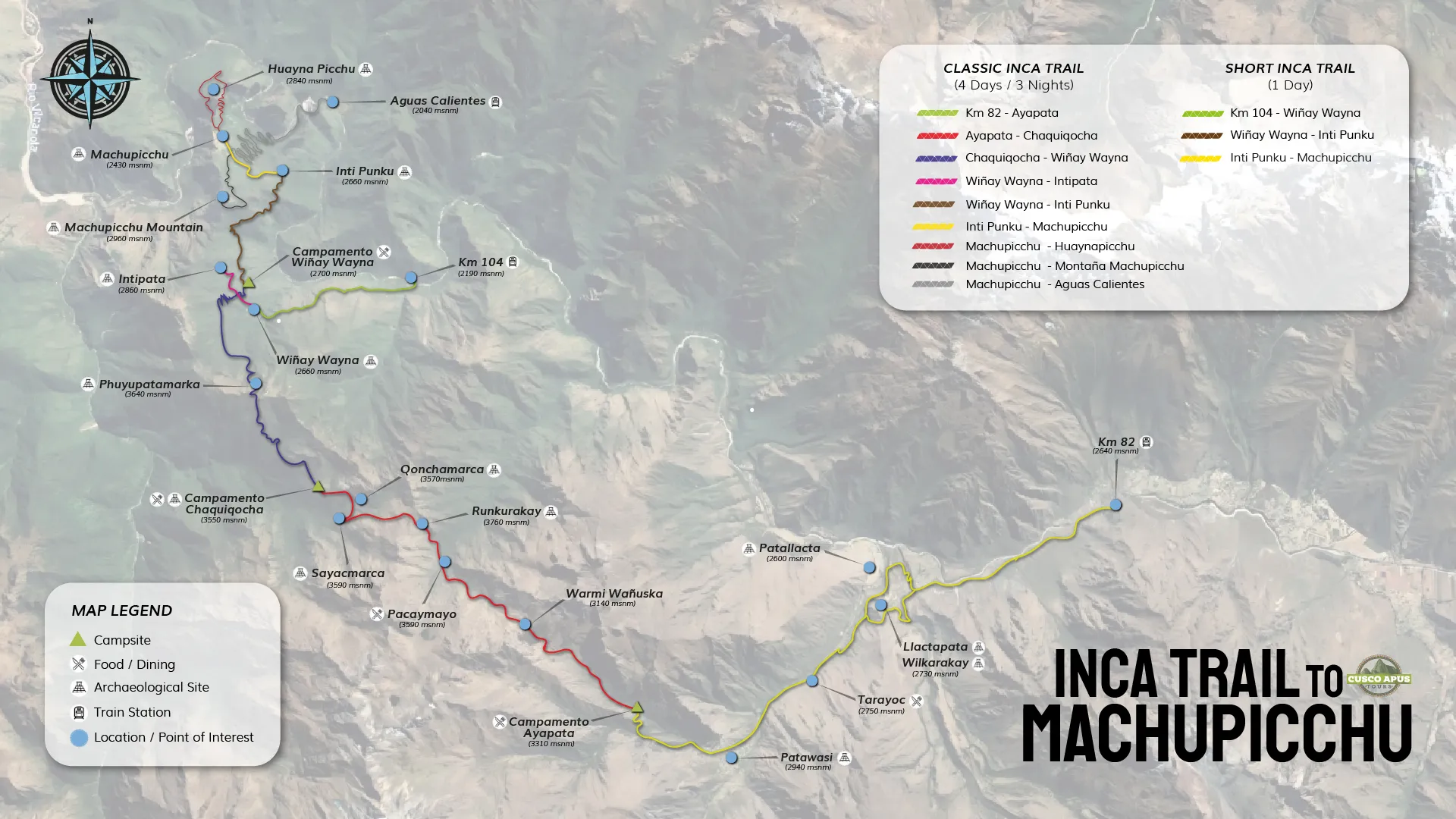
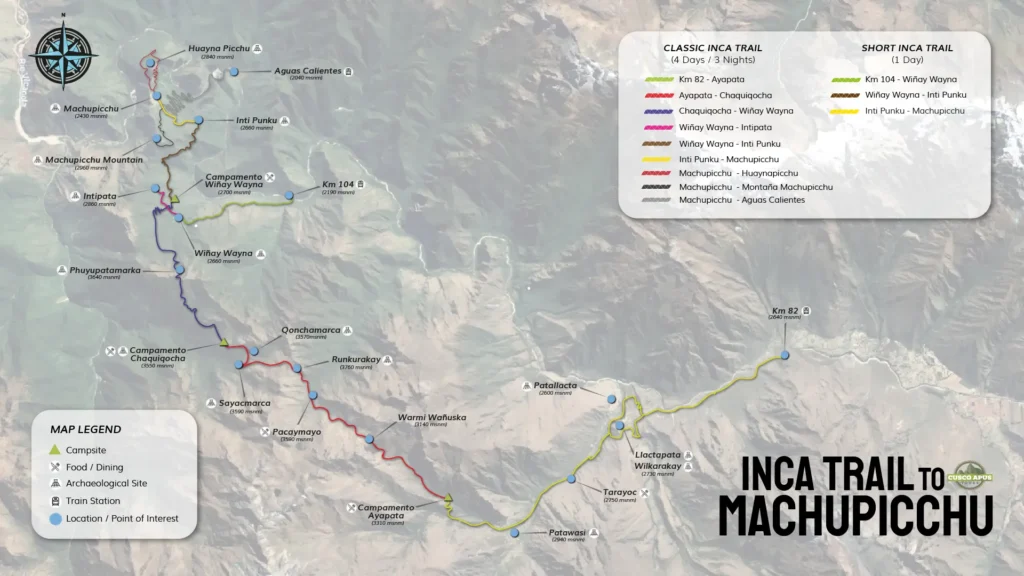
A technical map is essential for your safety and enjoyment, detailing critical variables:
- Checkpoints and Mileage: From the trailhead at the railway to the entrance of Machu Picchu.
- Archaeological Sites: Exact locations of ruins like Llactapata, Sayacmarca, and Wiñay Wayna.
- Official Campsites: Authorized zones managed by the government for overnight stays.
- Altitude Profile: Indicators in meters and feet to anticipate physical exertion.
4. Main Routes on the Inca Trail Map
Depending on your time, budget, and fitness level, the map is divided into two official versions:
The Classic Inca Trail (4 Days / 3 Nights)
The “star” route. It starts at Kilometer 82 (Piscacucho).
- Day 1: Moderate hike passing through Llactapata.
- Day 2: The hardest stretch. Ascent to Warmiwañusqa Pass (Dead Woman’s Pass), the highest point at $4,215 \text{ m}$ ($13,828 \text{ ft}$).
- Day 3: Descent into the cloud forest, visiting Runkurakay and Phuyupatamarca.
- Day 4: Early morning arrival at Inti Punku (Sun Gate) for the sunrise over Machu Picchu.

The Short Inca Trail (2 Days / 1 Night)
Designed for those with limited time. It begins at Kilometer 104. It consists of a single-day hike ($\approx 12 \text{ km}$) connecting directly with Wiñay Wayna and reaching Machu Picchu by the afternoon of Day 1.

Route Comparison Table
| Feature | Classic Inca Trail | Short Inca Trail |
| Total Distance | 43 km (26.7 miles) | 12 km (7.5 miles) |
| Duration | 4 Days / 3 Nights | 2 Days / 1 Night |
| Starting Point | Km 82 (Piscacucho) | Km 104 (Chachabamba) |
| Highest Point | 13,828 ft ($4,215 \text{ m}$) | 8,923 ft ($2,720 \text{ m}$) |
| Difficulty | Challenging / Moderate | Moderate / Easy |
5. Critical Preparations and Logistics
- Ultra-Limited Permits: Only 500 permits are issued daily (only about 200 for tourists). Book 5 to 6 months in advance.
- Acclimatization: Spend at least 2 days in Cusco before the trek to avoid altitude sickness (soroche).
- Essential Gear: Broken-in trekking boots, waterproof jacket, a 20-30L daypack, and trekking poles with rubber tips.
6. Weather: When is the Best Time to Go?
- Dry Season (May to September): Best time. Sunny days and clear skies. Nights are freezing at high campsites.
- Rainy Season (November to March): Lush green landscapes and fewer crowds.
- Important: The Inca Trail is CLOSED every February for environmental maintenance and safety.
7. Sustainability and Impact
Responsible tourism is a duty. As conscious travelers, we must strictly apply Leave No Trace principles: carry out all trash, respect wildlife, and never deface Inca structures.
Conclusion
The Inca Trail map is the blueprint for one of the most enriching experiences of your life. Conquering its passes and seeing Machu Picchu emerge through the mist from the Sun Gate is a reward that justifies every ounce of effort. Plan ahead, respect the mountain, and get ready to connect with the living history of the Andes!